
White Paper
Is the Impurity in a Battery Cathode Powder Conductive?
Four lithium iron phosphate lots, a few unexplained XRD peaks, and what SEM contrast adds
Blaise Mibeck · Cubic Labs LLC · November 2026
Download PDF All articles and white papers
Backscattered-electron contrast suggests the secondary phase is not an iron phosphide. The phase is tentatively lithium phosphate, an electrical insulator, pending EDX analysis of the particles.
The question
A battery materials company sent four lots of lithium iron phosphate (LiFePO4) cathode powder. XRD showed highly crystalline LiFePO4 and 1 to 3 wt% graphite, which is added on purpose to improve conductivity. It also showed a few weak, unassigned peaks near 34° and 48° 2θ, estimated below 1 wt%. The open questions were what the extra phase was and whether it mattered for cell performance.
Two explanations tested
First, the weak peaks might be background noise. Iron fluoresces under the Cu Kα X-rays used by most diffractometers, which raises the background and can hide small peaks. Narrowing the detector’s pulse-height window from 48–80% to 52–80% reduced the background by about 40%. The peaks remained.
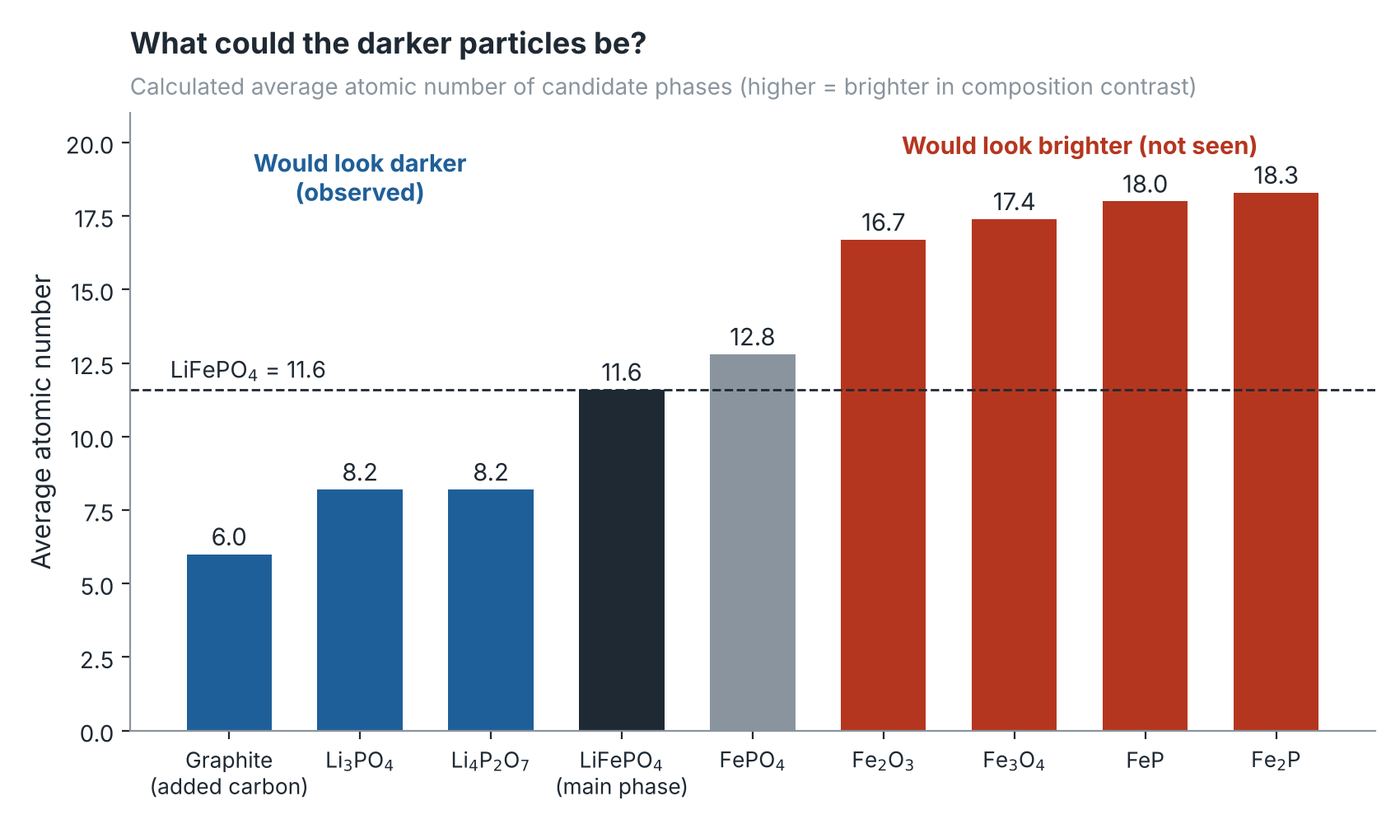
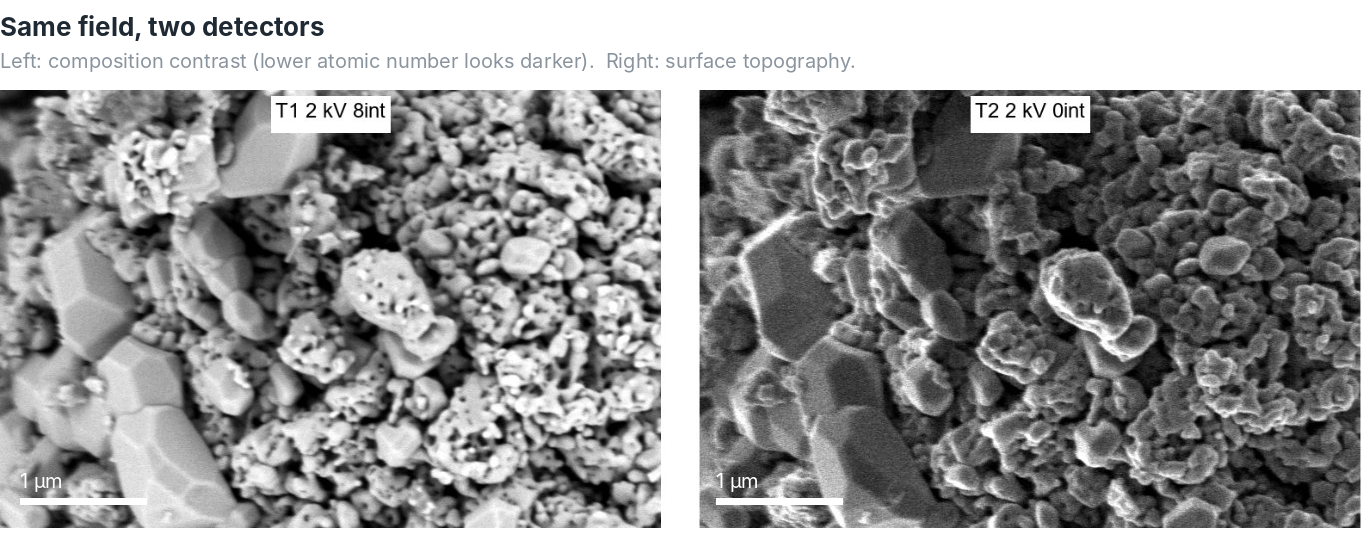
Second, the impurity might be an iron phosphide, which conducts electricity and could affect cell performance. In backscattered-electron contrast, phases with a higher average atomic number appear brighter, so an iron phosphide (average atomic number 18.0 for FeP) should stand out against LiFePO4 (11.6). SEM showed no bright particles. It showed a second population of larger, rounded particles (1 to 5 µm) that looked darker than the LiFePO4 crystallites.
What remains
Two candidates with a low average atomic number remain: lithium phosphate (8.2), an electrical insulator, and carbon (6.0). Graphite does not produce a peak near 34°, while lithium phosphate does, so the XRD points to lithium phosphate. The assignment is tentative. I recommended EDX analysis of the rounded particles, which would separate lithium phosphate from iron phosphate. At the estimated level, an insulating phase should have little effect on a cell.