
Industrial & Manufacturing Problem Solving

When something unexpected shows up in your manufacturing process, accurate identification is the first step toward a solution. We characterize unknown materials, contamination, and product anomalies using combined analytical techniques.
Common Manufacturing Challenges We Address
Parts that pass inspection and still fail
such as die castings. CT resolves features above roughly 200 µm, and many pores are smaller. Reprocessing the CT data can show a lower-density zone, and SEM of a polished section or fracture surface shows what the zone is. In one case, pores of 50 to 500 µm sat where a part broke. Read the white paper.
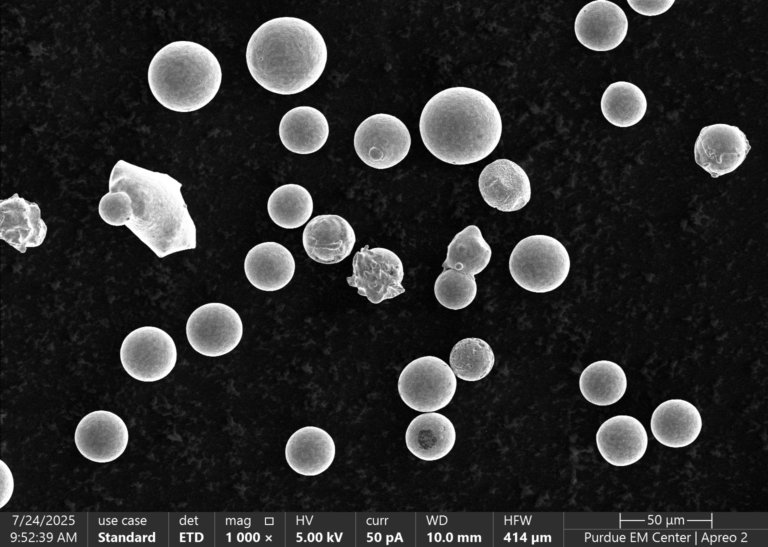
Unknown particles or contamination
in products, coatings, or raw materials. Using SEM-EDX for elemental composition and morphology, combined with XRD for crystalline phase identification, we can determine both what the contaminant is and likely sources.
Coating or surface treatment failures
where visual inspection isn't enough. Our approach combines surface analysis (SEM-EDX) with bulk characterization (XRF, XRD) to understand both surface chemistry and underlying substrate interactions.
Material property changes
in production. When mechanical properties, appearance, or performance shift unexpectedly, we identify compositional or structural differences using quantitative XRD analysis and elemental mapping.
Quality control for composite materials
including fiber-reinforced plastics, mineral-filled polymers, and metal matrix composites. We quantify filler content, distribution, and identify contamination that affects performance.

Internal structure analysis
using advanced 3D CT image processing. We analyze fracture networks and pore structure in rock samples, internal defects in manufactured products, and connectivity patterns in complex materials. This includes quantitative measurements of volumes, apertures, and 3D connectivity.
Analytical Approach
Rather than running standard tests, we work with you to understand the specific problem and select the right combination of techniques. Most manufacturing issues require multiple analytical methods - XRD for crystalline phases, XRF for elemental composition, and SEM-EDX for microstructural details and spatial distribution.
Our 22+ years of materials science experience helps identify the most informative analysis strategy and interpret results in the context of manufacturing processes.
Sample Requirements
We work with small samples - often just a few grams or even particles collected on tape. Typical turnaround is 3 to 5 business days for pycnometry, 5 to 7 for XRF, 7 to 10 for XRD, and 10 to 14 for SEM-EDX. Contact us to discuss your specific situation and sample preparation needs.
Ready to Solve Your Manufacturing Problem?
Contact us to discuss your specific challenge and how our analytical expertise can help identify the root cause.
Get Started Request Quote