
Environmental & Industrial Problem Solving
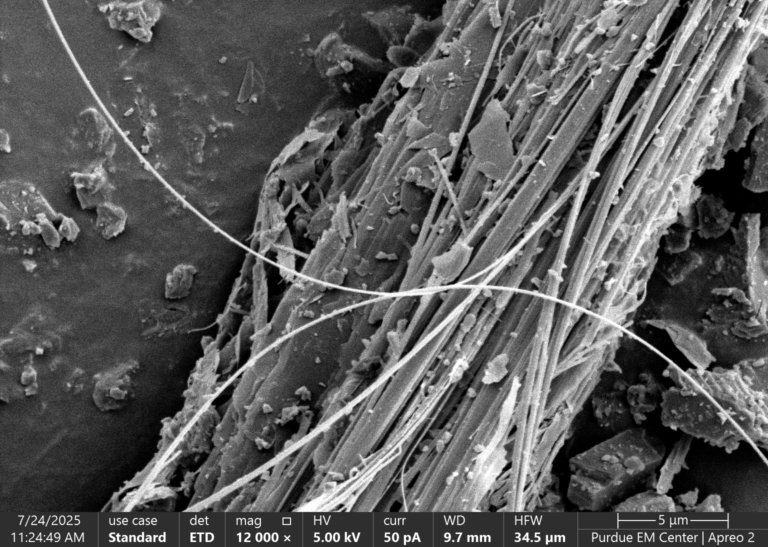
We identify unknown materials and contaminants across diverse applications, from environmental assessment to troubleshooting industrial processes.
Environmental Applications
Contamination identification
in soils, sediments, and industrial waste. Combined XRD/XRF analysis identifies mineral phases and elemental concentrations for environmental assessment and remediation planning.
Air filter and dust analysis
using SEM-EDX to determine particle composition and sources. We identify heavy metals and industrial contaminants in workplace and environmental samples.
Water treatment scale deposits
and fouling materials. XRD identifies mineral phases while XRF determines elemental composition to understand formation mechanisms and select appropriate treatment methods.
Unknown white deposits and silica screening
from combustion vessels, filters, and process equipment. Density, XRD, and XRF together can show whether a silica deposit is mostly amorphous. The crystalline fraction is an estimate, and exposure decisions need confirmation at an accredited lab (NIOSH 7500 or OSHA ID-142). Read the white paper.
Leach-test failures
when total composition passes and the leach result does not. Combining XRF, XRD, SEM, and the leach data can show which factor, such as the final pH of the test fluid, separated failing and passing batches. Read the white paper.
Construction material evaluation
including lead paint analysis and identification of minerals in drywall or insulation materials.
General Industrial Applications
Unknown material identification
when you need to know "what is this?" We analyze particles, deposits, corrosion products, and foreign materials found in industrial processes.
Alloy identification
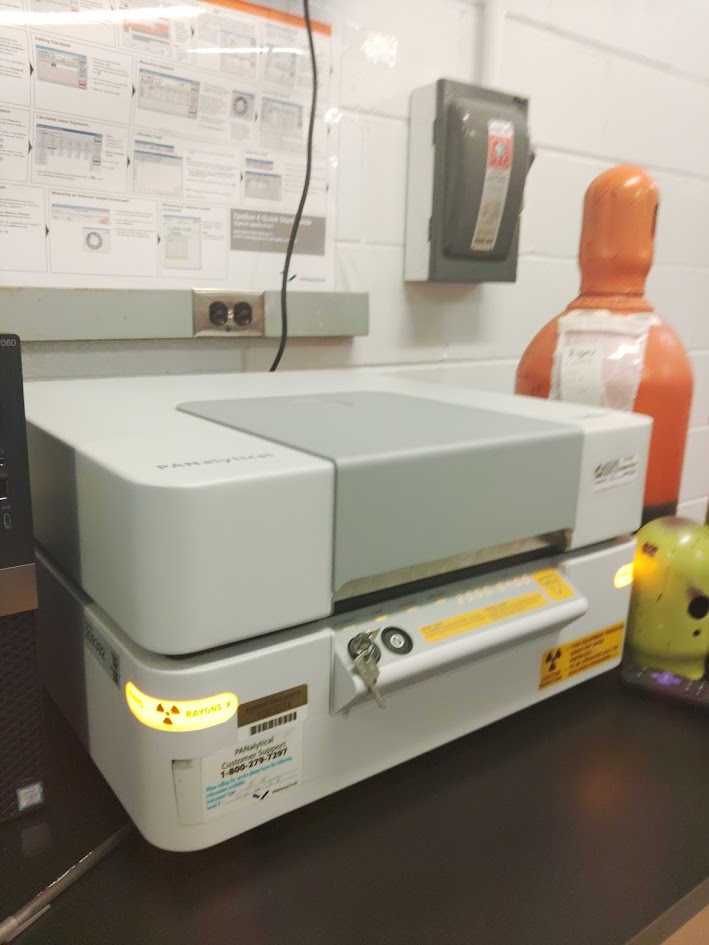
and composition verification using XRF analysis. Rapid elemental analysis for quality control, scrap sorting, and materials verification.
Salvaged steel and unmarked metal
with no mill certificate. XRF shows composition, including elements such as phosphorus and sulfur that affect weldability. XRF cannot measure carbon, and the result informs engineering judgment without replacing a certificate. Read the white paper.
Product contamination analysis
including foreign particles in food packaging, pharmaceutical products, or consumer goods. SEM-EDX provides elemental composition and morphology data for source identification.
Failure analysis support
through materials characterization of fracture surfaces, corrosion products, and degraded materials.
Analytical Strategy
We select the most appropriate combination of XRD, XRF, SEM-EDX, optical microscopy, and CT analysis based on your specific questions. Our approach focuses on providing actionable information rather than standard test results.
Note: We are not currently certified for regulated testing applications but provide analytical services for decision-support and research purposes.
Most projects require 1-10 grams of sample material. Typical turnaround is 5 to 7 business days for XRF, 7 to 10 for XRD, and 10 to 14 for SEM-EDX. A photo and a short description are enough to start, and client details are never shared, and results stay confidential to you. Contact us to discuss your specific analytical needs and sample requirements.
Need to Identify Unknown Materials?
Contact us to discuss your analytical challenge and how our multi-technique approach can provide the answers you need.
Get Started Request Quote