
White Paper
Clay Mineralogy: Sample Preparation and Four Cross-Checks
Oriented-mount XRD on three soil samples, checked against particle size, bulk XRD, XRF, and pycnometry
Blaise Mibeck · Cubic Labs LLC · November 2026
Download PDF All articles and white papers
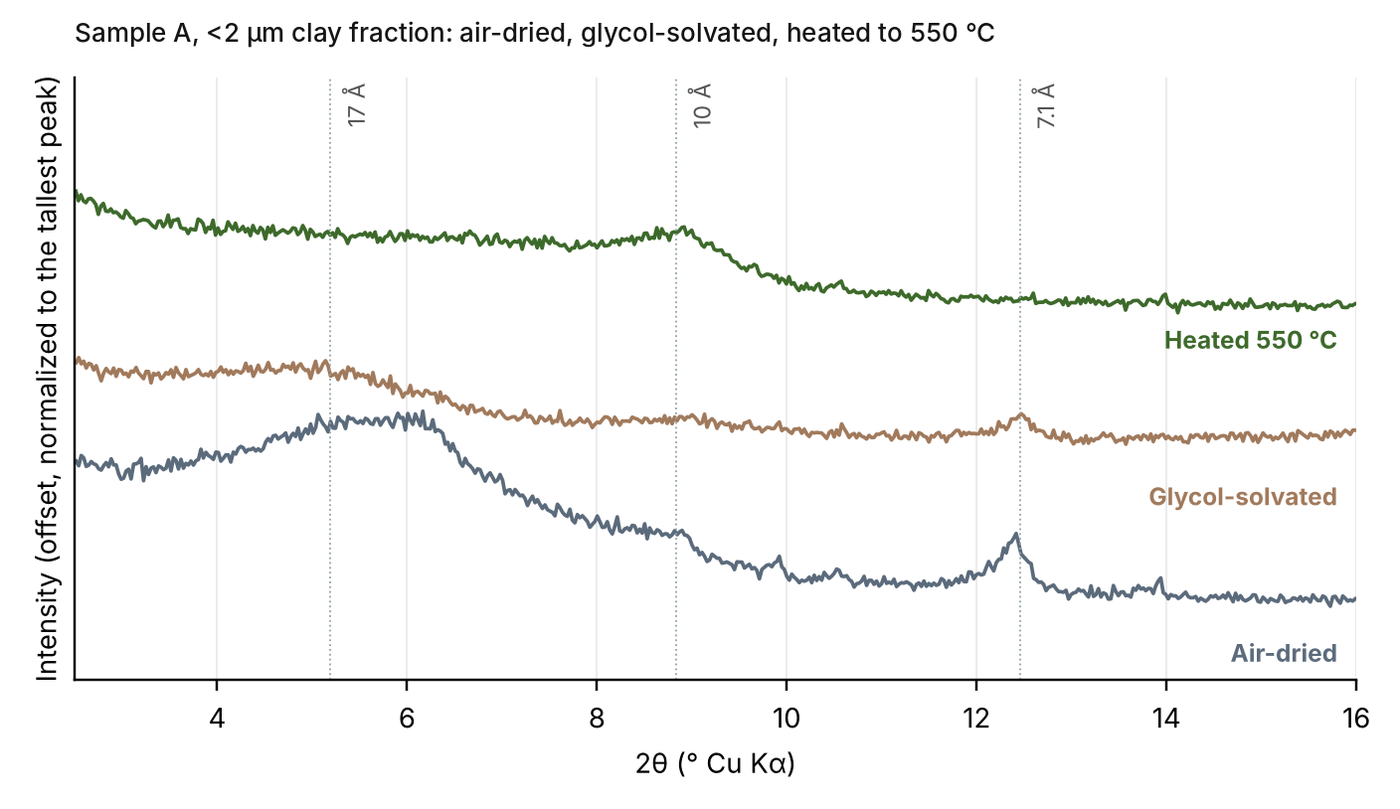
Swelling clay made up about 24 to 50% of the clay peak area, illite-type clay 38 to 63%, and kaolinite 10 to 18%. These are semi-quantitative shares of the clay peaks and do not give total mineral content.
The question
Three soil samples, one question: which clay minerals could be holding the potassium? The clay was close to colloidal and stayed suspended, so most of the work happened before the diffractometer. The preparation used a dispersant, repeated settling and centrifugation, carbonate removal with buffered acetic acid, and a Stokes-law cut at 2 µm. Oriented mounts were scanned air-dried, glycol-solvated, and heated to 550 °C. That sequence separates swelling clay from illite and kaolinite (Figure 1).
Four cross-checks
- Particle size: the clay-rich sample was about 32% finer than 2 µm, which checked the separation yield.
- Bulk XRD: quartz dominated, up to about half the sample. Clay came to near 62% in the clay-rich sample, almost double the separation yield, and in one sample a change in the background fit moved bulk smectite between 23% and 3%. I took the clay proportions from the oriented mounts.
- XRF: the clay-rich sample was highest in K, Al, and Rb, which fits illite layers hosting much of the potassium, with some from K-feldspar in the silt and sand. It also held far more iron than the crystalline phases could account for.
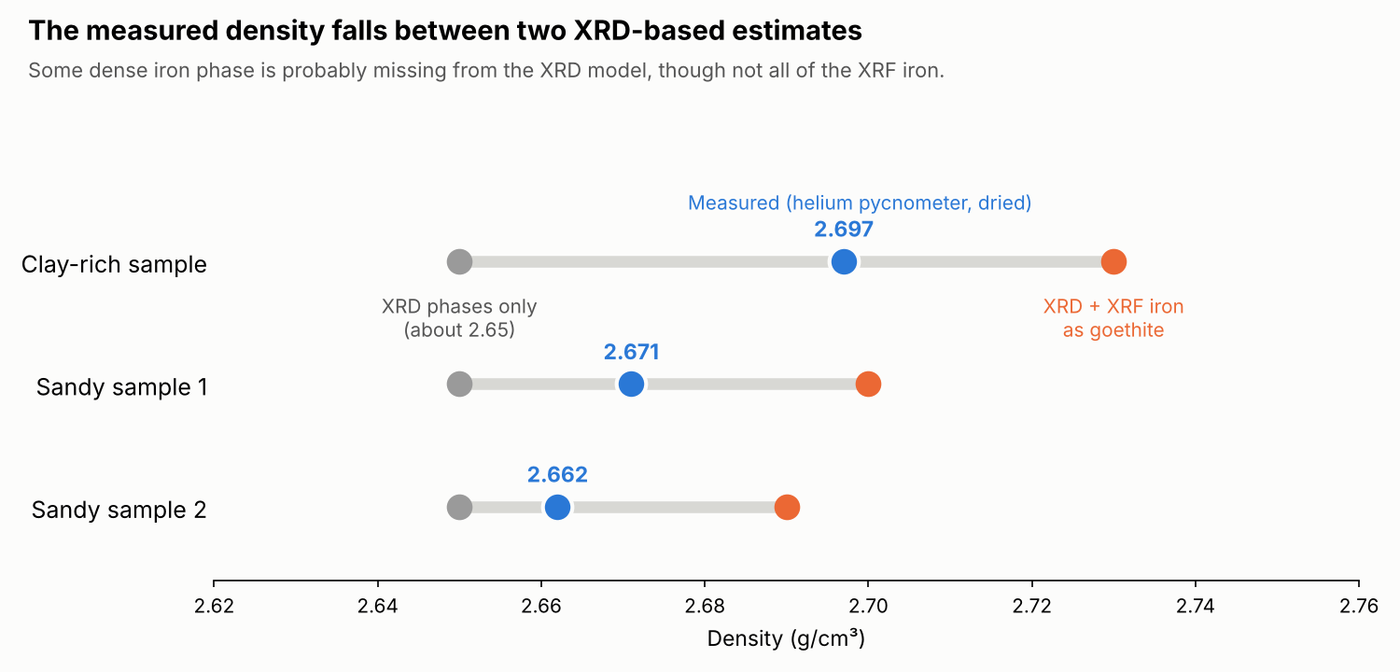
- Helium pycnometry: dried-sample densities of 2.66 to 2.70 g/cm3 sat above what the XRD phases predict (about 2.65) and below what adding all the XRF iron as goethite predicts (Figure 2). Some dense iron phase is probably missing from the model, but probably not all of the iron.
Why the split matters
Clay type decides whether a soil swells, how a ceramic body fires, and how a formation reacts to water. The preparation and the cross-checks turn a pattern into a result you can act on.