
White Paper
Density Plus XRD: A Bad Lot or a Bad Reference?
Helium pycnometry and Rietveld XRD on a mullite powder that read below its reference density
Blaise Mibeck · Cubic Labs LLC · November 2026
Download PDF All articles and white papers
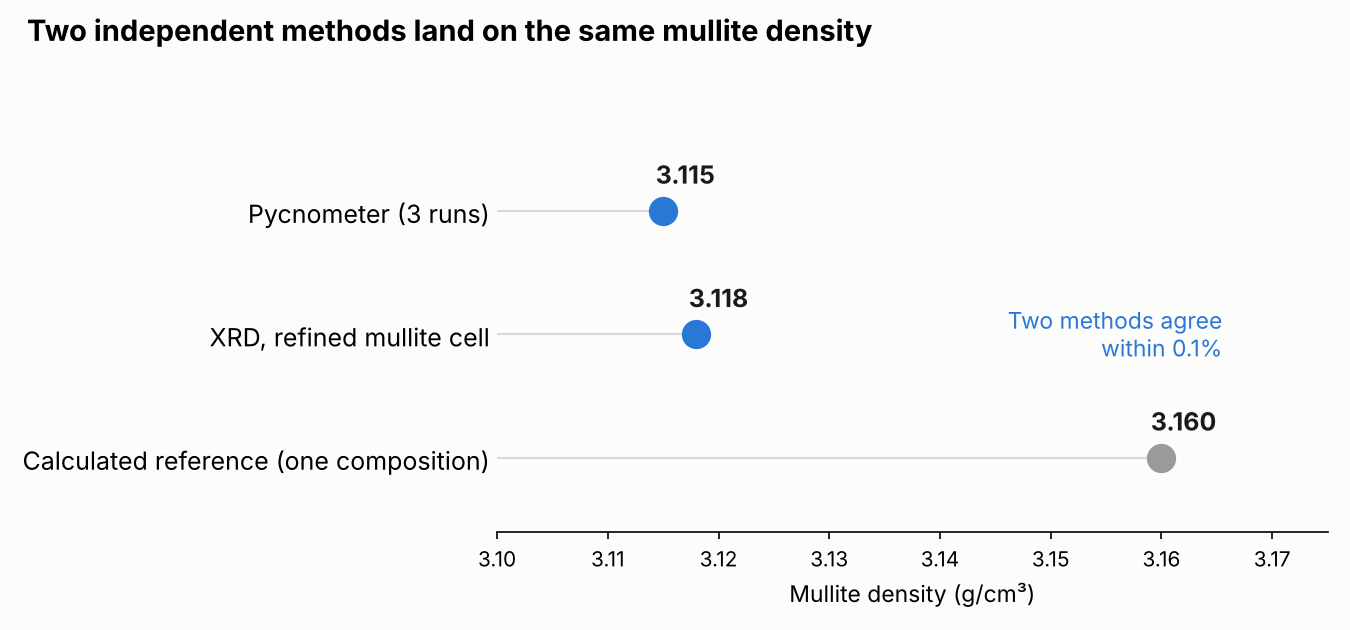
Mullite read 3.115 g/cm3, 1.4% below the 3.16 reference. The XRD refinement gave a calculated density of 3.118 g/cm3, so the measurement was sound and the generic reference did not describe this lot.
The question
A research group needed the true density of four powders to model porosity in a powder-based additive process. I measured each in triplicate by helium pycnometry. All four came in under 0.2% relative standard deviation, and calcium carbonate read 2.7237 g/cm3, within 0.5% of calcite’s reference value of 2.71.
Mullite read 3.115 g/cm3, 1.4% below the calculated 3.16 that mineral references list. Three runs agreed to 0.03%, and calcite had just landed on its reference with the same instruments, so the measurement was behaving. The powder differed from the reference.
What XRD showed
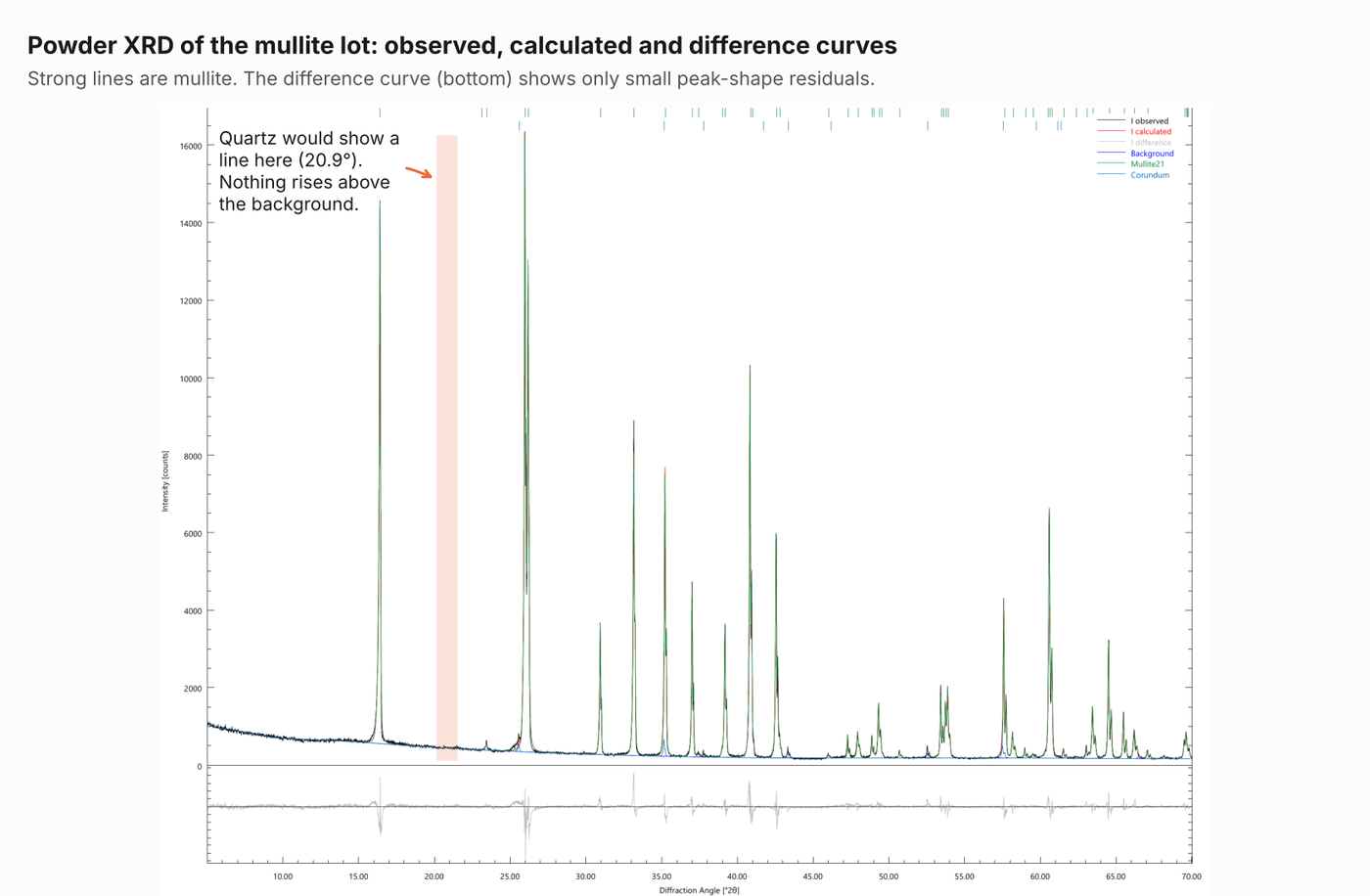
Density alone offered two suspects: a lot from the alumina-rich end of mullite’s solid solution, which is slightly lighter, or free quartz, which by a simple mass balance would take about 7 to 8% to explain the gap. A Rietveld refinement found mullite with about 1.5% corundum and no quartz line above the background at 20.9°, where one should appear. The refined mullite cell gives a calculated density of 3.118 g/cm3, within 0.1% of the pycnometer. Quartz’s strongest line at 26.6° sits on the tail of the mullite doublet, so a trace cannot be excluded. The XRD density also assumes the composition in the structure model, so the two methods are close to independent, but not fully so. Mullite is a solid solution, and the 3.16 reference describes one composition within it. This lot sits elsewhere in the range.
Why the second measurement matters
The reference density feeds every porosity, shrinkage, and part-weight calculation downstream, and it shapes how you judge an incoming lot. A bad lot means a conversation with the supplier. A bad reference means a corrected model. Without the second measurement you cannot tell which one you have.