
White Paper
How Far to Trust a Pycnometer Density
Helium pycnometry of a polymer powder at three particle sizes
Blaise Mibeck · Cubic Labs LLC · November 2026
Download PDF All articles and white papers
Three particle sizes gave two densities. Particle size alone should not change a true density, so different batches or grades are the likelier explanation. The cycle data and bed photos show how far to trust each value.
The question
A client needed reference true densities for three particle-size fractions of a polymer powder, 85, 15, and 6 µm. I measured each by helium pycnometry with ten cycles per run. The 85 µm powder measured 1.2050 g/cm3. The 15 and 6 µm powders measured 1.2099 and 1.2098 g/cm3, each with a standard deviation of 0.0002 g/cm3. Helium pycnometry measures the volume of the solid, so particle size alone should not change the result. The fractions more likely came from different batches or grades.
What the cycle data show
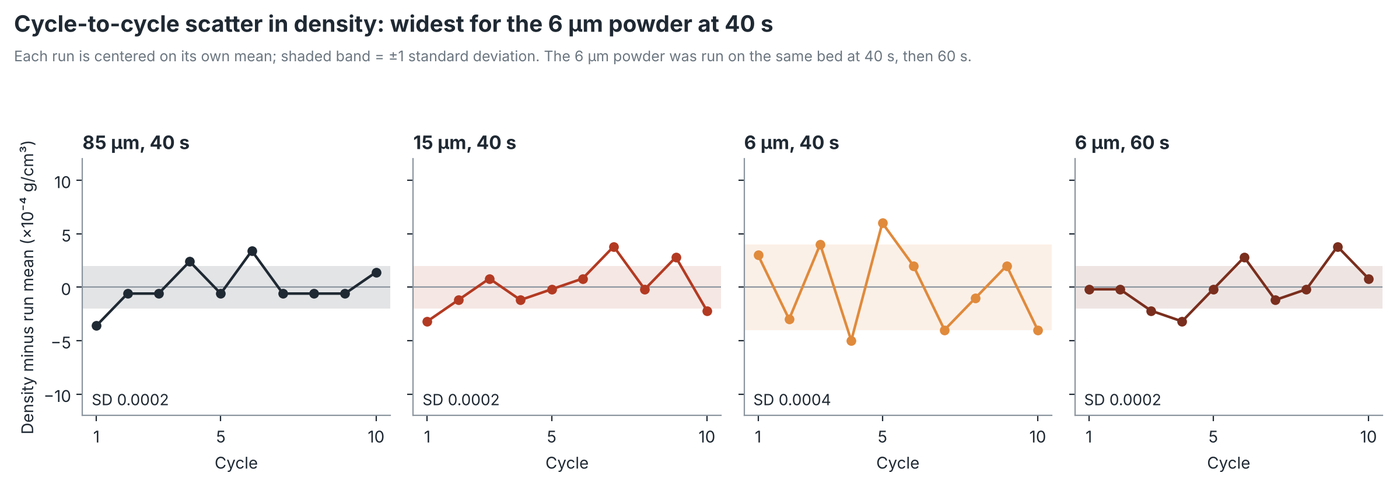
The 85 µm and 15 µm powders were steady from cycle to cycle at a 40 s equilibration time (Figure 1). The 6 µm powder at 40 s swung up and down, with twice the standard deviation of the other runs (0.0004 against 0.0002 g/cm3). The same powder at 60 s gave 0.0002 g/cm3.
What the powder bed shows
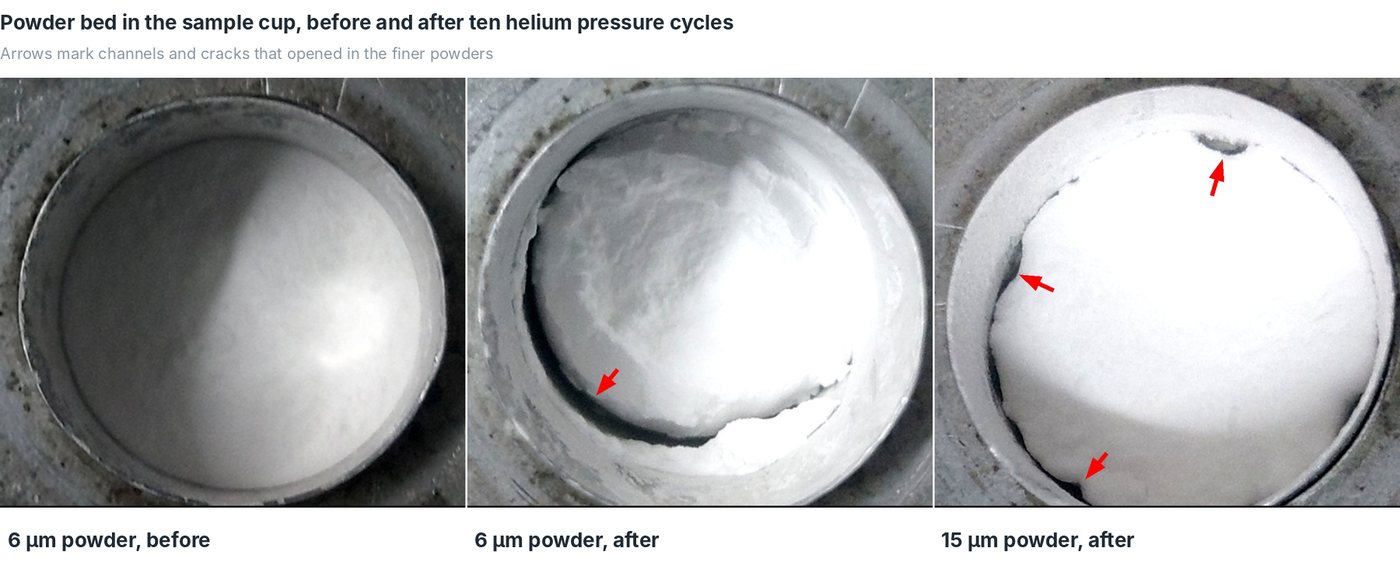
I photographed the powder bed before and after each run (Figure 2). The 85 µm bed stayed flat. The 15 µm bed cracked, and the 6 µm bed formed channels along the cup wall. Fine powder is cohesive, and each pressurization shifted the bed, which gave helium different pathways from cycle to cycle.
What this means for the number
An average hides this. For fine powders I recommend a 40 to 60 s equilibration time and a cup filled to half or less. Report the density with its standard deviation and its protocol.